
A convoluted story
A journey with nearly as many twists and turns as the railway itself, the story behind the building of what we now know as the Welsh Highland resulted from a range of plans and attempts to build a railway in the highlands of Snowdonia.
Early History

The early origins of the Welsh Highland Railway begin with the building of horse-drawn tramways carrying slate from the quarries in the Nantlle and Croesor valleys down to the harbours in Porthmadog and Caernarfon. The Nantlle Tramway was designed by George Stephenson but eventually rebuilt as part of the standard-gauge Carnarvonshire Railway from 1867, which the North Wales Narrow Gauge Railways (NWNGR) and later WHR had an interchange with at Dinas. The Croesor Tramway became a part of the Porthmadog Beddgelert and South Snowdon Railway (PBSSR) between Croesor Junction and Porthmadog, with the remainder horse-drawn and tractor operated until closure.
The NWNGR first opened in 1877 as a 3-mile line between Dinas and Bryngwyn joining an incline up to slate quarries on Moel Tryfan. The railway was then extended forming a branch, which later became the main line, up to South Snowdon, now Rhyd Ddu. The railway had five locomotives over its lifetime.
Further south, plans were formed by the North Wales Power and Traction Company for a railway connecting quarries in the Nant Gwynant valley with Black Rock sands near Porthmadog using an electrified railway powered by a hydro-electric powerplant, part of their wider scheme. This was part-built between 1901 and 1906 but never completed, and the railway was never electrified. Some of the structures built can be seen from the train around the Aberglaslyn Pass.


Creation of the Welsh Highland Railway
The NWNGR had elaborate plans as part of its proposed “General Undertaking” for lines reaching from Caernarfon and Porthmadog as far as Corwen via Capel Curig and Betws-y-Coed. These plans would have seen a railway network totalling over 60 miles.
Following financial difficulties at both PBSSR and NWNGR, they were acquired by the Aluminium Corporation of Dolgarrog in 1918 and 1922 respectively. This led to the revival of the plans to link Dinas and Porthmadog through the creation of the Welsh Highland Railway. The railway was completed in 1923 by McAlpine & Sons.
The WHR was never profitable as the expected traffic from the quarries on the railway never materialised due to their decline. The railway had ageing locomotives and rolling stock, and couldn’t compete with the local bus service for passenger traffic, and entered receivership only four years after it was completed. However trains continued to run until 1933.
The Ffestiniog Railway (FR) took over operations in 1934 with a lease of the line for 42 years. This saw a shift in the emphasis of the line towards the tourist passenger market with brightly painted carriages, promoting the Aberglaslyn Pass and offering round-trip tickets via the WHR, FR and standard-gauges lines. This period also saw the WHR locomotives ‘cut down’ so that they could fit within the restricted loading gauge of the FR significantly altering their appearance.


Final Decline and Closure
Despite the best efforts of the FR to turn the Welsh Highland around, this was ultimately in vain as the railway was still unprofitable. The last passenger train ran on 5 September 1936, and goods trains ceased in 1937.
Following this the line remained derelict for a number of years, with the track being taken up in 1941 for the War Effort marking the end of the original Welsh Highland Railway.
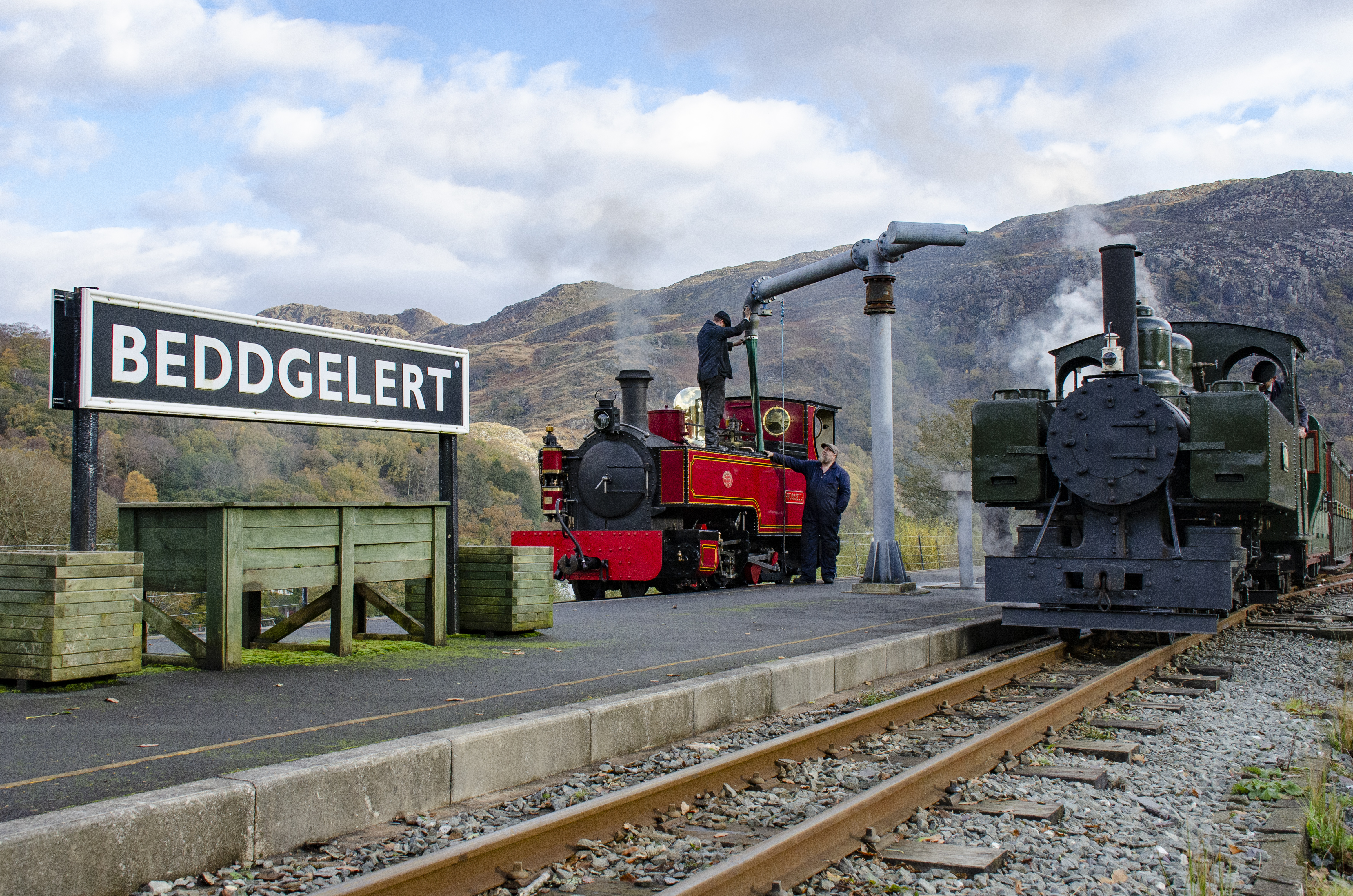
The first attempts at preserving the Welsh Highland started in the 1960s by what is now the Welsh Highland Heritage Railway (WHHR), also referred to as the ’64 Company. Unable to obtain the land of the original WHR, the Company acquired the former Beddgelert Siding from British Rail which acted as an interchange between the original WHR and the Cambrian Railways, later Great Western Railway, for the transhipment of slate and other goods. The WHHR has established a museum featuring the history of the railway and has gathered a collection of original and replica locomotives, rolling stock, and buildings.


Rebuilt: The dream thought impossible
The Ffestiniog Railway Company (FRCo) controversially placed a bid with the Official Receiver in 1989 for the trackbed of the original WHR. Following years of legal battles, the FRCo finally received a Transport & Works Order to enable the transfer of ownership from the Official Receiver and to reconstruct the railway, with work starting on the first section of the line between Dinas and Caernarfon on the former Carnarvonshire Railways trackbed in 1997. This section opened in the same year marking the start of the rebirth of the Welsh Highland Railway
Due to the steep gradients of the WHR, the railway had to look far to find locomotives powerful enough to pull long trains on the completed railway. These came from South Africa in the form of NG/G16 Garratts, the most powerful 2ft gauge steam locomotives in the world, and were imported along with two diesels and other items of rolling stock.
The railway opened section-by-section thanks to huge public support and the efforts of numerous volunteer gangs starting with Waunfawr in 2000, followed by Rhyd Ddu in 2003, Beddgelert in 2009, and Pont Croesor in 2010. The railway finally opened through to Porthmadog in 2011, bringing the Welsh Highland Railway to life.


Today
Whilst the railway opened in 2011, there has still been plenty to do to finish the job. Porthmadog Harbour Station was significantly remodelled completing in 2014, and a brand new terminus at Caernarfon constructed opening in 2019.
We have plenty of ambitious plans to realise the potential of the WHR, and you can join us as we carry on the journey to keep the dream alive.


 English (UK)
  Cymraeg